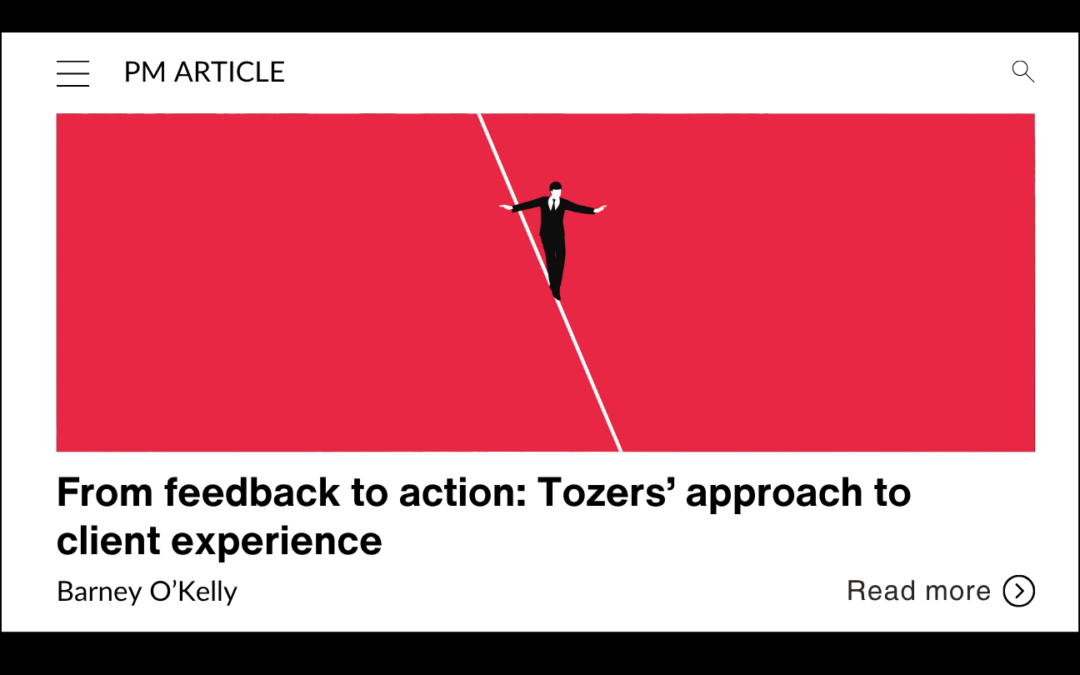
Good marketing takes risks. But in professional services, where risk is engineered out, that creates tension, says Barney O’Kelly
I’ve spent the better part of two decades working in professional services marketing. Long enough to have watched the same conversation happen in enough different firms, in enough different cities. I’ve stopped being surprised by it…
Professional services organisations are, by design, extraordinarily effective risk-management machines. Every function in the building exists to stop bad things from happening. HR manages the risk of people. Finance manages the risk of money. Legal manages the risk of aberrant behaviour. The whole apparatus is finely tuned to mitigate, manage and, wherever possible, eliminate, risk. On the whole, it works.
This is as it should be. Professional services firms deal with matters of consequence for their clients. Their people are privy to highly sensitive information. Reputation is everything. One screw up can be existential. We’ve all seen this happen.
This creates huge challenges for marketing teams.
In a business where risk is so carefully engineered out of the system, being paid to take risks is at best anomalous, at worst anathema. Nevertheless, good marketing should take risks.
Firms want to differentiate themselves (they nearly always fail).
This requires bold moves. Being bold enough to be noticed, distinctive enough to be remembered, and provocative enough to move someone from indifference to action.
This creates enormous tension. Conditions for good marketing inside a professional services firm are, by design, close to hostile. Not because anyone’s malicious. Because the system is designed to manage and mitigate risk and was never built with boldness in mind.
This creates a fundamental lack of trust in marketing teams.
Ideas need endless levels of approval. Consensus – the enemy of creativity – needs to be achieved. Alignment matters. An idea that started out as exciting, provocative, challenging – something that could really make the firm stand out – slowly gets suffocated.
Inevitably it ends up in a room where someone senior says, “I don’t get it,” or “I don’t like it.”
And everything changes.
Not because the idea was wrong. Not because the audience wouldn’t have responded to it. But because someone senior in the room confused being the audience with understanding the audience, and nobody felt equipped to explain the difference.
So, the work gets revised. The edges come off. What emerges is something inoffensive, unmemorable, and entirely consistent with every other piece of communication that firm – and every other firm – has ever produced. Dreams of differentiation die.
This is not a story about one firm. It’s a story played out every day in firms everywhere.
So how has marketing responded? Poorly.
It has decided to mimic its other functional friends. They have data. We need data. Here’s some data. Oops, it’s crap data.
Marketing, in an attempt to ‘earn its seat at the table’, started to rely on data. Look, we have numbers too. It didn’t really work. And I’m not sure it’s got better.
Why? Because, irony of ironies, in an environment where attribution is almost impossible to determine, the really good data resides in the heads, inboxes and personal spreadsheets of the practitioners. And they don’t want to share it.
Marketing is left with the scraps – page views, social media engagement, email click-throughs – data that poses questions, not answers. In an attempt to be taken seriously, Marketing has often done itself more harm than good.
Marketing is not a calculation. It is a judgement. It’s not devoid of analysis. Quite the opposite. But the numbers are in the wrong place far too often. Instead of being at the end of the process, they should be at the beginning.
So, the business starts to ask difficult questions. “What does this mean?”, “What did this cost?”, “How many leads did this generate?”
Marketing’s work gets assessed using sales measures. Its cost is assessed, its intentions misunderstood and the wrong consequences are expected.
Sooner or later, someone says, “What was the ROI?”
Something that was designed to do one thing – reposition a business, address misconceptions, reinforce a proposition – is now measured in an entirely inappropriate way.
Now, bear in mind, your internal audience is invariably smart. High levels of intelligence tends to be accompanied by a low boredom threshold. This means the wrong measures are now being applied over too short a timeframe to show impact.
Something that would have created impact over months, years even, is now being measured in weeks.
Dissatisfaction starts to creep in. “Our marketing department is useless,” “They’re just the colouring in department.”, “They’re not commercial,” “They don’t understand the business.”
This is why professional services CMOs don’t last long. It’s not that they’re bad; they’re not given the time, the space, the grace to deliver the long-term, meaningful impact that great marketing can achieve.
Instead of building brands, creating environments and demonstrating their organisation’s distinctiveness (I don’t believe differentiation is a realistic goal for most professional services firms, but I’ll save that for another day), they’re asked to create a sales pipeline.
In businesses where much of their marketing is experiential – based on the work delivered, the way it was delivered, the way the client was managed – everything is marketing. Or nothing is.
So, this systemic failure to embrace the risks marketing is carefully creating, is hugely counter-productive, wasteful and frustrating for everyone involved.
If professional services firms really want to stand out, scale and achieve their growth ambitions, listening to their marketing teams’ bold ideas would be a good place to start. The next time your marketing team brings you an idea, don’t start with “I don’t get it.”
And to the marketers… Back yourselves. If you believe in it, make others believe in it too. The next time someone says “I don’t get it,” help them. Don’t just knock the hard edges off to get it agreed. That’s just a waste of everyone’s time. ■
Barney O’Kelly is Head of Solutions and Product Marketing at AlixPartners.
Members only: if you want to add this reading to your CPD, please log in and complete the evaluation
Log in