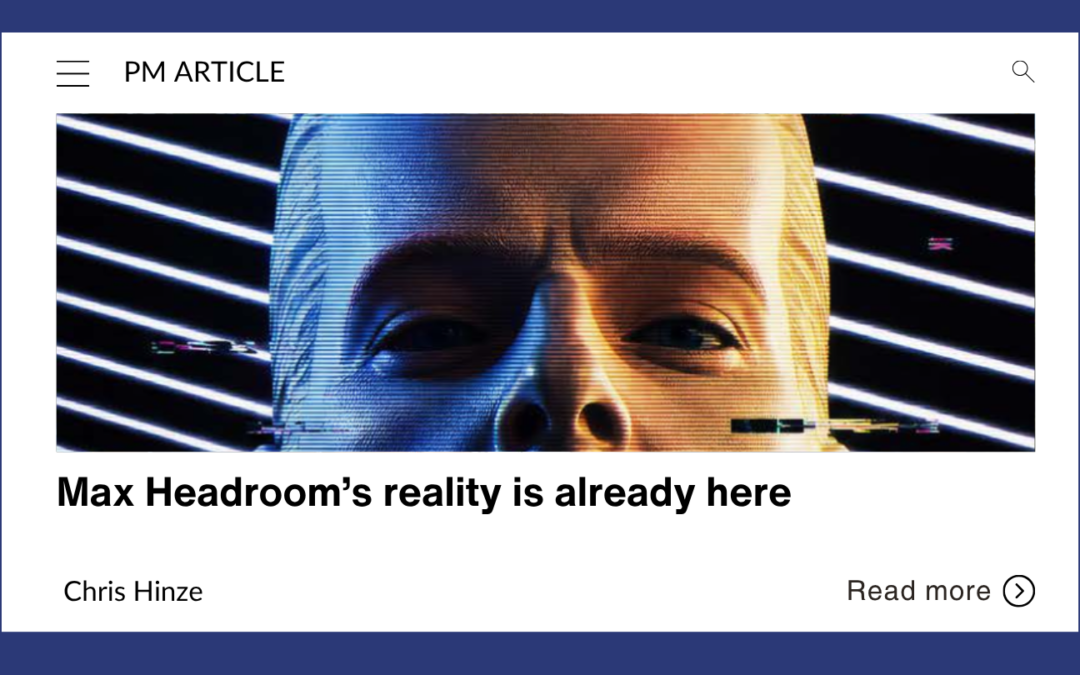
The artificial spokesperson has arrived – polished, scalable and endlessly available. But when digital avatars start speaking for business leaders, who, asks Chris Hinze, is really accountable for what they say?
There’s a peculiar loop in how we imagine the future: we invent a fictional technology to satirise the present, then quietly build it a few decades later.
In the 1980s, the British movie and then US television show, Max Headroom, did exactly that. The premise was simple – a brash, glitchy television personality who appeared to be a computer-generated host but was in fact derived from the mind of a real human, journalist Edison Carter, whose consciousness is digitised and distorted following a car crash.
Max wasn’t just a program; he was a compressed, caricatured version of a person, stripped down to quirks, catchphrases and traits. Father-of-cyberpunk author William Gibson also addresses the possibility in several of his stories including having a hacker recorded and stored in Neuromancer and a paralysed artist named Lise copied and uploaded in The Winter Market. They are more authentic copies than Max, but copies, nonetheless.
Jump forward nearly 30 years to the television series Westworld.
In one of the show’s most memorable scenes, William asks a park host: “Are you real?” The reply is simple: “Well, if you can’t tell, does it matter?” The question is critical because it asks what difference does realness make in practice?
These are no longer academic questions. And it has come up in a couple of discussions I’ve had in my own industry with counterparts at other law firms.
We live in an emergent media environment where these personalities are increasingly real. Synthetic presenters, AI-generated spokespeople and endlessly reproducible talking heads. Tools like Synthesia allow companies to generate polished video presenters who can deliver scripts in multiple languages, with consistent tone, appearance and cadence. These figures don’t get tired and don’t go off message. They are the logical endpoint of the Max Headroom idea: not a chaotic, personality-driven digital ghost, but a clean, optimised communication layer wearing a human face. The current state of technology can also drive some of us deep into the uncanny valley but hey, as someone else has said to me, the technology will only get better.
If an artificial spokesperson can deliver a message as effectively as a human, then why bother with a real one if the audience engages, understands and responds in the same way?
What matters is clarity, consistency and scalability. An artificial spokesperson can be rapidly updated, speak multiple languages and deployed across markets without the friction of traditional video production. They don’t have competing calendar appointments, need make-up, have hangovers, or need to do multiple takes in order to get the shot and tone just right. Sounds like a win to anyone who has tried to get a video shoot done at short notice.
But here comes the kicker. And it is where we get back to Max Headroom. Max wasn’t an artificial personality.
He was built from a real person’s mind.
So is that the future? A synthetic copy of a real CEO delivering an online quarterly update might be more polished than the real one. A law firm partner talking in a brief online video can save significant billable time by simply telling their digital avatar what to say rather than putting themselves through several takes in front of a video camera or doing a shaky recording on their phone.
So how far can we push this? It is the lawyer who is responsible for complying with the rules of professional conduct, even if the work is done by members of their marketing or communications team or agency and they need to sign off on all content.
But that doesn’t mean they need to be the creator, just the approver.
We see this already in a range of areas.
A quote from a lawyer in a press release is rarely uttered out loud or even written by them. A client alert might have been ghostwritten. The same for a presentation. And tools such as Copilot or Claude make the authoring even easier. So, if their digital representation says it then is there really a difference? Does it really matter if the lawyer is not as articulate in real life or lacks a presentational polish of their own?
If the viewer responds in the same way and either doesn’t care or doesn’t notice the difference, then we’re back to Westworld. The question isn’t whether the artificial version is ‘real’, but whether the distinction has any real meaning so long as it is accurate.
And this is where the catch arises. A realistic digital avatar that simply repeats what it is told to say, with control and approval factored in, is one thing. A realistic digital avatar that takes a body of information and then autonomously puts its own interpretation on it and states it by itself without any oversight is something completely different.
Trust, accountability and responsibility are critical factors. If something goes wrong, whether in terms of the accuracy of the information or its interpretation, then we are heading down a rocky path.
It doesn’t matter then whether the digital personality is a real one or entirely artificial one. And in the law firm world someone still has to be accountable. And it has to be the lawyer.
Max Headroom was a warning wrapped in humor: a world where identity could be commoditized and broadcast as a product. Westworld sharpens that into a question about indistinguishability. And guess what?
It probably doesn’t matter. Until it does.
We are moving from a world where media features humans to one where our humanity itself is a configurable attribute. Personality becomes a layer that can be designed, tuned and deployed. The ‘talking head’ is no longer a person who speaks, but a system that performs the role of speaking.
And somewhere in that transition, Max Headroom stops looking like satire and starts looking like a taste of the reality that is already here. ■
Chris Hinze is the Chief Marketing and Business Development Officer at law firm Steptoe LLP based in Washington, DC. He spent most of his career in London, including the role of Global Head of Communications for Hogan Lovells and has frequently appeared on CMO and communications roundtables and panels on law firm reputation management, positioning and branding, and mergers.
Members only: if you want to add this reading to your CPD, please log in and complete the evaluation
Log in