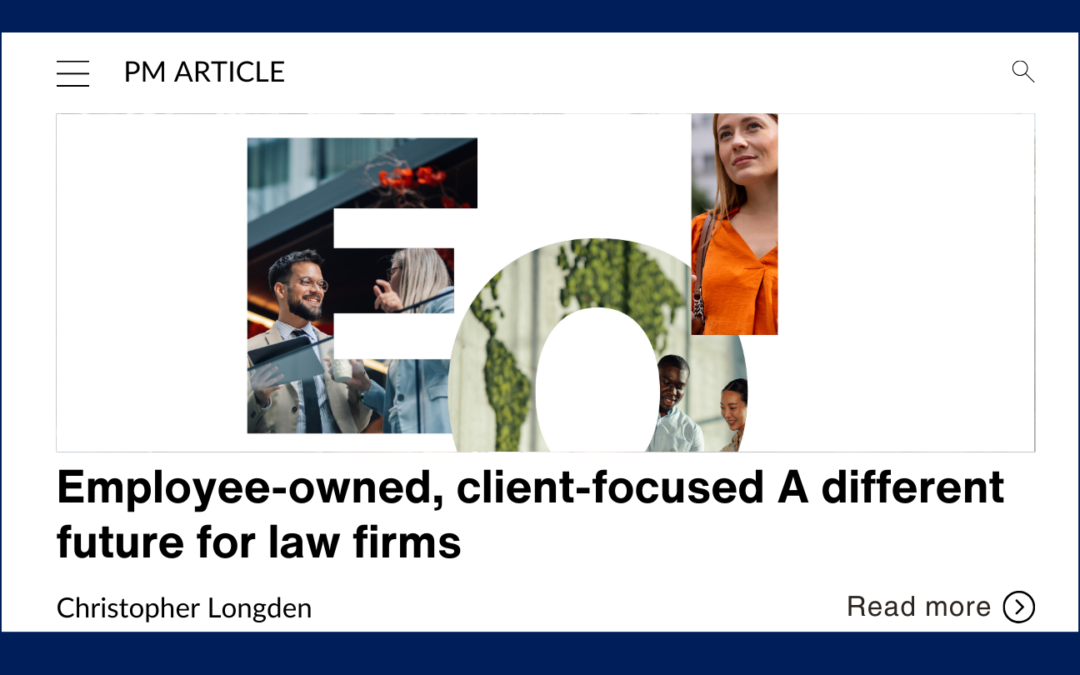
Kent law firm Whitehead Monckton has turned its back on private equity investment, transitioning into an Employee Ownership Trust. Its Managing Director Christopher Longden explains why.
Whitehead Monckton, a leading law firm based in Kent, has taken two major steps towards cementing its commitment to excellence in client service and changing the way we see lawyers.
Already one of the South East’s best known and recommended firms, Whitehead Monckton prides itself on being different from the average law firm.
The firm’s approach to client service is based on working in partnership with its clients, reinforced by our recent transition to an Employee Ownership Trust (EOT), placing majority ownership into a trust on behalf of their 126 employees. It is just one of 40 law firms to make this bold move.
Becoming an EOT is largely about making sure control of the business stays within the business. There is a trend for private equity funds to buy into law firms. We didn’t like the idea of that happening, as it can result in a firm being forced into an aggressively profit-driven cycle, creating difficulties with succession.
Being an EOT keeps us aligned with our values and culture – benefiting the employees who work so hard for our clients – whose interests are at the heart of everything we do.
What does it mean for staff and clients?
Investing in our team ultimately translates to investment in our clients. Their interests have always been at the heart of everything we do, and everyone in the firm understands and cares about the impact of legal issues on our clients’ lives, businesses and careers, going above and beyond to help them achieve their aims, reduce the risks and minimise the stress.
Putting ownership of the business into a Trust on behalf of all our employees means everyone has a vested interest in our success. So for our clients, becoming an EOT means even better service and stronger relationships.
Our staff now have a stronger voice in the firm through governance structures designed for transparency and engagement. We have formed an Employee Council, which provides ideas and feedback to the board of the Trust company. Employees have the opportunity to participate in or present ideas to the Employee Council and then to the Trust Board. It means that everyone now owns what we do for our clients.
Good internal communications is a fundamental part of that change. It is mission-critical that people understand why the business is transitioning, what it means for them, and how it affects their day-to-day. Now that the transition has been completed, staff expect transparency around business performance, governance, management decisions and long-term strategy. Effective communications helps establish and build a shared sense of ownership and accountability.
For clients, anecdotal feedback suggests that they understand the positive nature of the move, and acknowledge its impact on the firm’s long-term stability. Clients tend to feel that knowing that the people who deliver their legal services have a genuine stake in the business strengthens their trust and confidence.
Brand building
Alongside the transition to an EOT, the firm recently launched a refreshed brand, designed to help people find the legal services they need more easily, and to reflect the firm’s human, client-centred approach to law.
We’ve always been very conscious that many people – particularly private clients – still see lawyers as, at best, a bit stuffy and bound up in legal jargon. Many people aren’t sure who to talk to – especially if they’ve never really had to engage with lawyers before. We want to offer the reassurance that we’re human first and lawyers second, and that we genuinely care about achieving the best outcomes for our clients. Our rebrand is largely about that – seeing ourselves as our clients see us, and offering practical information and signposting in plain English.
The colourful new brand palette is a far cry from the palette favoured by more traditional firms, and is designed to make the firm’s six teams more visible, with clear signposting to relevant services for individuals and business clients.
It allows the firm’s marketing team to shape marketing and business development activity around specific issues affecting people’s personal or business lives, rather than focusing on the technical areas of law that might not be familiar to non-lawyers. At the same time, it allows communications to be more easily tailored to the needs and interests of specific audiences. Whoever Whitehead Monckton is talking to, a firmwide commitment to ditching the legal jargon and making the complicated simple makes communications clearer and more accessible.
Additionally, Whitehead Monckton launched a podcast, ‘Headnotes’, in late February. It breaks down the latest developments in law, offering clear, practical insights into everything from buying property to changes to employment rights to the complexities of surrogacy and adoption, showing that law doesn’t have to be complicated – it just needs to be clear.
Making this change takes us another step towards transforming the way people see lawyers – giving them even more confidence in a firm that’s always there when they want them, and which knows them so well that they can often predict their needs. Above all, we’re firmly committed to the idea that when employees own the business, they go the extra mile for you.
Christopher Longden is the Managing Director of Whitehead Monckton.
Members only: if you want to add this reading to your CPD, please log in and complete the evaluation
Log in