AI is changing more than legal workflows. It is beginning to reshape the economics of law firms themselves, says Libby Maynard.
Artificial intelligence can now analyse documents, retrieve authorities, review contracts and produce draft advice in seconds. Much of the debate in legal circles has focused on efficiency: if machines can do in minutes what once took hours, surely costs must fall.
But that conversation misses the bigger shift.
AI is not just changing how legal work is done. It is reshaping the economics of law firms themselves.
For decades, legal practice has relied on leverage. A small group of partners sits at the top, supported by layers of senior lawyers and a wide base of juniors. Those juniors do the heavy lifting – research, document review, drafting – and their time is billed at a margin that funds the firm and drives profit.
The real question isn’t whether firms will adopt AI: it’s what happens to the traditional model when much of the ‘thinking work’ at the base of the pyramid is automated.
From tasks to categories
Early in my career as an articled clerk, much of the work was repetitive: photocopying, indexing, managing data rooms. Over time, that work disappeared. Paper became digital. Libraries became databases. Firms adapted.
What feels different now is the speed and scope of change.
Earlier technologies automated individual tasks. AI is now automating entire categories of work. Activities that once took hours can now be completed almost instantly, and the capability is improving fast.
This isn’t quite the ‘automation of thinking’. AI is not exercising judgement. But it is automating the analysis and synthesis that underpin legal work, the layer that once sat at the base of the pyramid. And that has economic consequences.
A shift in leverage
If machines take on a meaningful share of research, review and drafting, the traditional source of leverage begins to shift. The pyramid doesn’t disappear, but its foundations change.
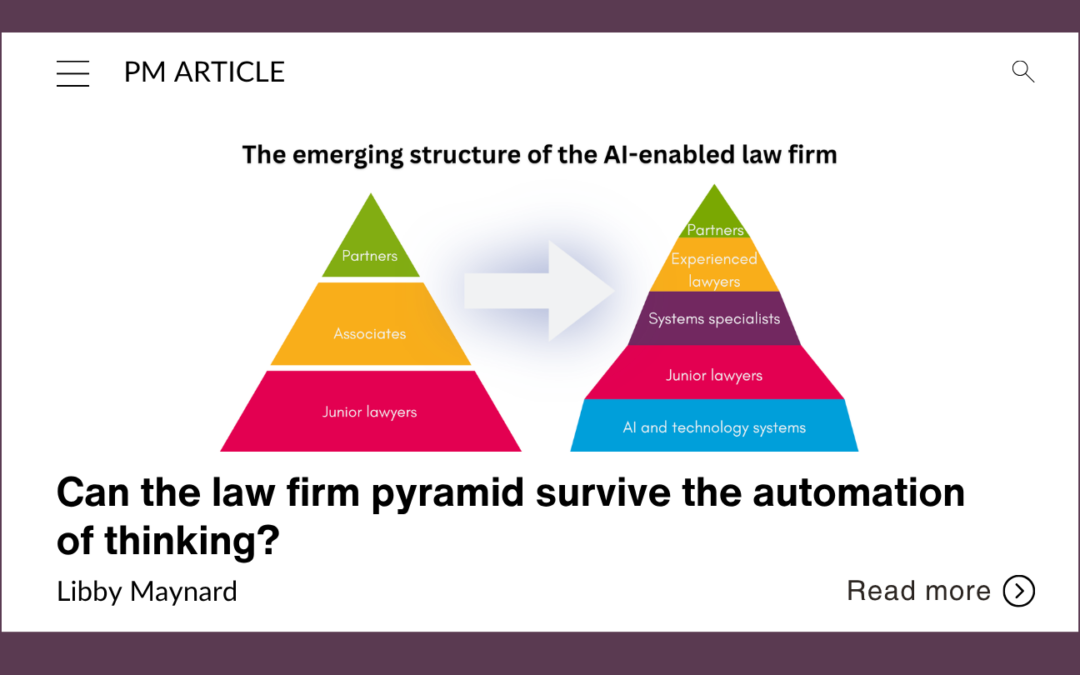
In an AI-enabled firm, leverage is less about junior labour and more about a mix of technology, knowledge and capability. The shift is already changing the shape of firms. Alongside lawyers, a new layer is emerging: systems specialists. These are people who design workflows, structure knowledge, build AI prompts and translate data into insight. They are not peripheral; they are part of the service delivery.
The model is also becoming more complex. Partners focus on judgement, relationships and risk. Experienced lawyers connect analysis to advice. Systems specialists design how work gets done. Junior lawyers focus more on validation and critical thinking.
AI provides scale and speed.
The pyramid remains, but it has been rewired.
What clients really pay for
The billable hour has long bundled together different sources of value. Clients paid for time, but embedded within those hours were expertise, judgement and accountability. As AI reduces the time required for many tasks, that bundle starts to unravel.
If work can be done in minutes instead of hours, the link between time and value becomes harder to sustain. Yet the importance of the outcome hasn’t changed.
Clients want judgement. They want advice grounded in commercial reality. They want someone to take responsibility when the stakes are high. For all the focus on technology, the most valuable parts of legal work remain human.
In that sense, AI may make the value of senior lawyers more visible. When time spent on research and drafting shrinks, what remains is what clients were always really buying: judgement, experience and trust.
A familiar pattern
There are echoes here of the Industrial Revolution. Mechanisation transformed production, but it didn’t eliminate expertise.
Factories required engineers, managers and skilled operators.
They also required capital investment, and new ways of pricing and capturing value.
Professional services may now be entering a similar phase. AI becomes part of the production system, while lawyers focus more on interpretation, judgement and advice. But these systems require investment in technology, data and people.
A critical question sits underneath all of this: who captures the value created by AI?
Clients may capture it through lower fees. Technology providers may capture it through platform pricing.
Or law firms may capture it by combining AI with proprietary knowledge and expertise.
Firms that treat AI purely as a cost-saving tool may find margins squeezed if clients capture the benefits. Firms that can capture and structure their own knowledge – perhaps precedents, sector insights, pricing data – are better placed to create something distinctive. The strategic battleground may therefore shift from who has access to AI, to who best captures, curates and applies proprietary knowledge.
Those that use AI to enhance capability are more likely to improve profitability.
Rethinking the model
For law firm leaders, the challenge is not simply adopting AI. It is redesigning how their firms create and capture value.
That means investing selectively in technology that improves quality, not just speed. Treating knowledge as an asset and making it reusable. Rethinking how junior lawyers are trained as traditional apprenticeship tasks change. Bringing systems specialists into the core of the firm.
And critically, law firms must revisit their pricing. If the production model changes but pricing does not, tension is inevitable.
The traditional pyramid is unlikely to collapse. But it will evolve: from a model built on labour leverage to one built on knowledge, technology and capability.
In that world, the most enduring source of value remains what it has always been: the ability to interpret complexity, exercise judgement and earn client trust.
AI may simply make that truth impossible to ignore. ■
Libby Maynard is an independent consulting partner specialising in pricing, commercial strategy and business development for professional services firms. Having alternated between in-house roles and consulting, she brings insight from both sides, translating best practice into approaches that deliver results.
libbymaynard.com.au
Members only: if you want to add this reading to your CPD, please log in and complete the evaluation
Log in